How can heat be treated by adding fire? An article from the Chengdu University of Chinese Medicine explains the...
Tout
Latest posts
-
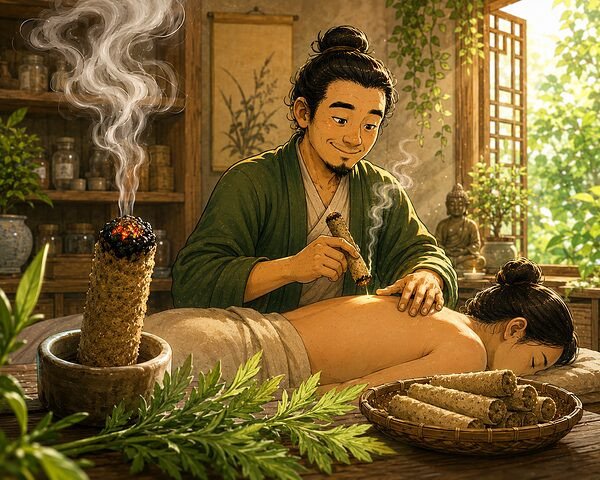 Moxibustion on Yong Quan (KI 1) to guide the fire back to its sourceRead more
 -
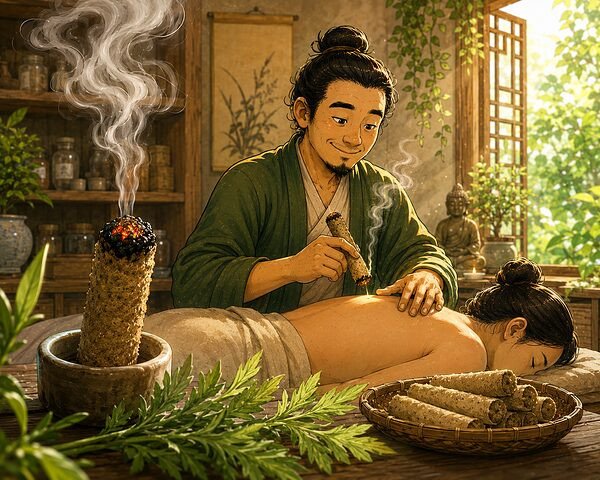 Moxibustion for insomniaRead more
Shi Mian and An Mian 4, two little-known points to warm with a moxa stick in the evening to re-anchor the yang and...
-
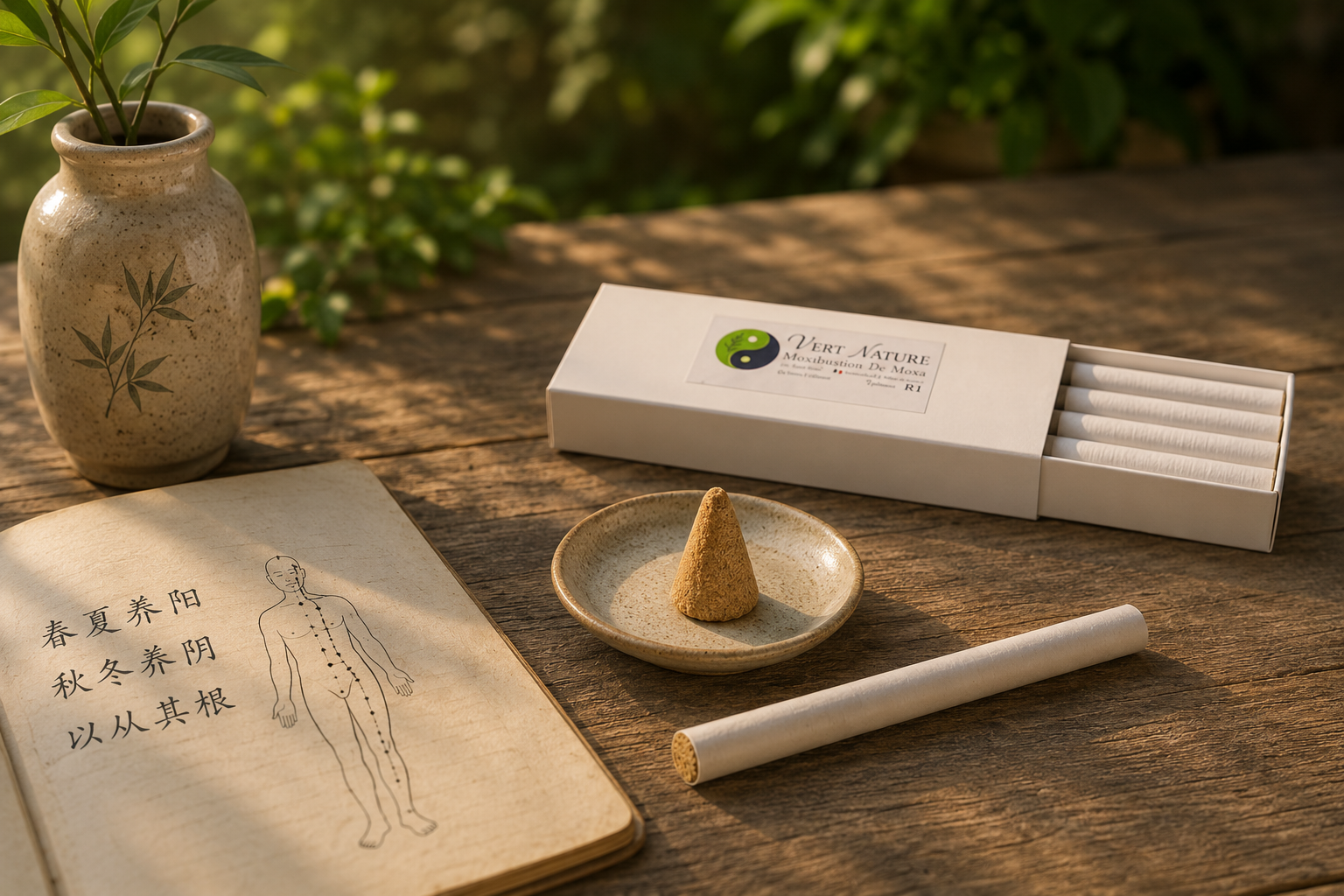 Moxibustion: Summer or Winter, When Should You Really Practise?Read more
As a moxa retailer, I notice a spike in orders every winter — even though the classical texts of Chinese medicine...
-
 Introduction to moxibustion techniquesRead more
Introduction to moxibustion techniques Moxibustion is practised using several techniques. Some are simple and can be...
-
 Safety of moxa smokeRead more
Moxa smoke: understanding scientific data without confusion Moxibustion involves the combustion of dried mugwort...
-
 Needle moxibustion: choosing the right equipmentRead more
Needle moxibustion: choosing the right equipment The warm-needle technique (needle moxibustion) rests on a balance...
-
 How to practise moxibustion at homeRead more
Moxibustion is a technique from Traditional Chinese Medicine (TCM) that involves stimulating precise points on the...
-
 Smokeless moxa: why it is less effective than traditional moxaRead more
Why we do not recommend smokeless moxa Therapeutic efficacy and a coherent choice Smokeless moxa is today widely...
Blog categories
Search in blog
Archived posts
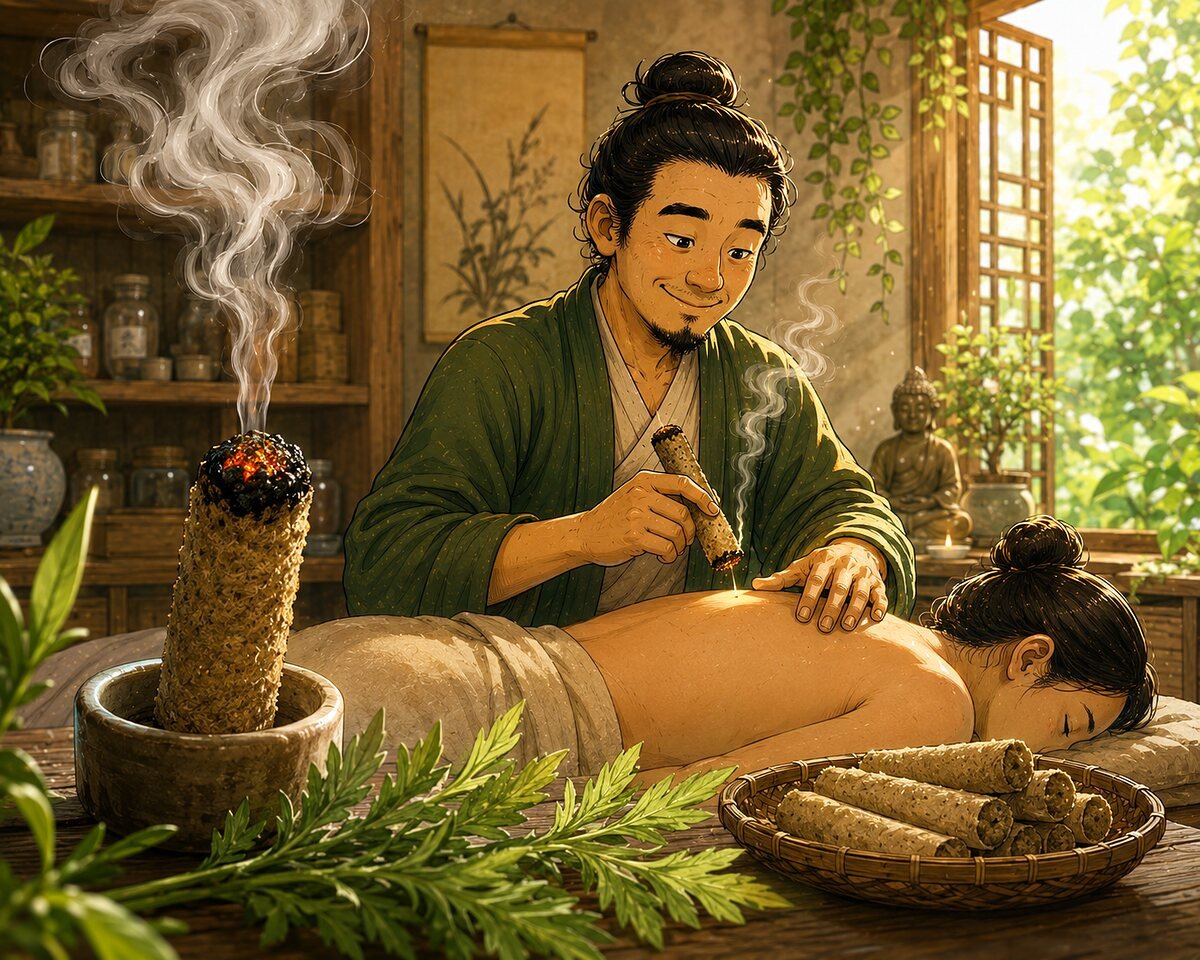
Moxibustion for insomnia
Trouble sleeping? Chinese medicine offers a tool that is often overlooked: acupuncture is what usually comes to mind for this kind of disorder, whereas moxibustion is particularly quick and effective.
This article presents two little-known acupuncture points and how to treat them with moxa. One clarification from the outset: these are extra-meridian, symptomatic points. They do not treat the root of the problem. They come as a complement to an underlying course of Chinese medicine, or for occasional insomnia.
Why warming the bottom calms the top
In Chinese medicine, one sentence sums up sleep: when the yang enters the yin, we sleep; when the yang leaves the yin, we wake. Insomnia is a yang that can no longer come back in, no longer dive into the yin for the night.
The question is why it no longer manages to. Three situations come up again and again, and they do not have the same cause.
The first is a deficiency of Kidney Yin. Our deep root grows poorer — age, fatigue, overwork, climate. Yet the Yin is to the Yang what water is to fire: as long as there is enough water, the fire stays covered, contained, in its place. When the water falls, nothing holds it any more, it loses its root and rises. The heat we then observe is not an excess of fire, it is a lack of water.
The second is a deficiency of Kidney Yang. This time it is the hearth itself that weakens. We would expect cold everywhere, and that is not what happens: the water of the Kidney, deprived of the warmth that kept it tepid, turns cold, and the little fire that remains no longer finds anything there to dwell in. It leaves its place and escapes upwards. Hence that disconcerting picture, so common in older people: frozen feet and a burning head in the same person, at the same time.
The third comes from above, with no initial failure of anchoring below: worries, rumination, undigested emotions stir the Shen directly, and it is that agitation which holds the Yang up above and prevents it from diving.
Three causes, one and the same picture: something has stayed above that ought to be below. The body is tired, the head is lit up, thoughts turn, sleep does not come. And one and the same therapeutic intention: to call back down what has settled up above.
That is the whole meaning of the Chinese therapeutic principle called yin huo gui yuan, translated as "leading the fire back to its source". Rather than fighting the heat where it shows itself, up above, we go and fetch it to bring it back where it belongs, down below. And this is where moxibustion on the sole of the foot takes on its full meaning: by warming the lowest point of the body, we offer that floating fire a hearth to come back down to. The Yang re-anchors itself in the Kidney, the Shen settles, and the heat comes down with it.
The paradox — applying heat to calm heat — is therefore no paradox at all, since the problem was never the heat itself, but the loss of its root.
The first point: Shi Mian, the "insomnia point"
The first point is called Shi Mian. The name translates literally as "insomnia point": shi mian means "loss of sleep" in Chinese, followed by the character for an acupuncture point. A point named, quite simply, after the condition it treats. This is the usual naming logic for symptomatic extra-meridian points, where the point is designated by the targeted illness rather than by a supposed virtue.
It is a modern extra-meridian point. It was named in the late 1950s in the journal of the Jiangsu acupuncture school, then illustrated and catalogued in the major atlases of extra-meridian points published in the following years. It is an empirical point, codified collectively during the great movement of inventory and standardisation of Chinese medicine of that era, at the time when the provincial schools and hospitals were being created.
Its location is simple. It lies exactly at the centre of the heel, at the lowest point of the calcaneus, on the sole of the foot. In the international coding of extra-meridian points it carries the reference CMI 22. To find it, trace an imaginary vertical line running from the prominence of the outer ankle down to the sole: the intersection with the centre of the heel gives you the point.
Its main function is to calm the mind and stabilise the Shen. It treats insomnia, but also pain in the sole of the foot and headaches.
To stimulate it with moxa, apply the heat of a mugwort stick for five to fifteen minutes, ideally two to three hours before going to bed.
A stop in Japan: Shitsumin
This point also exists in Japan, where it is called Shitsumin, and where it will rather be treated with Japanese moxibustion, with a rice grain — okyu.
The key point: Yong Quan, the gushing spring
Alongside Shi Mian, practitioners very often stimulate the point that embodies this logic better than any other: point 1 of the Kidney meridian, Yong Quan, whose name means "the gushing spring".
It is the lowest point of all the meridians, the Well point of the Kidney meridian, literally the spring from which energy emerges beneath the foot before irrigating the whole body. Warm moxa applied to it very quickly soothes hot flushes.
There is a precise, almost geographical reason for this. Yong Quan sits in the land of "extreme yin", zhi yin: it is the point furthest from the hearth of the fire, right at the bottom of the body. That is exactly what makes it so safe. Warming a point that low does not risk "adding fire to fire". On the contrary, the gentle heat of mugwort, by affinity, like calling to like, takes hold of the fire that was floating above and draws it downwards, to its deep dwelling in the Kidney.
This explains a remarkable property, developed in particular in work from the Chengdu University of Chinese Medicine on moxa at Yong Quan: this point works just as well when the yang is genuinely lacking as when it floats for want of being held. In both cases, it is brought home. Moxa here does not fight the heat; it repairs the anchoring that held it.
In practice, a gentle suspended moxa is used, called wenhe jiu in Chinese. The mugwort stick is held two or three centimetres from the skin, so as to produce a diffuse, bearable heat, never a burn. A classic trick for controlling the temperature is to place the index and middle fingers of the other hand on either side of the point: you then feel the heat in place of the skin being warmed. Hold for ten to fifteen minutes per foot, on both sides, in the evening before bed, precisely when you want the yang to come down and enter the yin. As a course, seven to ten consecutive days is common, possibly repeated after a few days' break.
Many practitioners add something that prolongs the effect through the night: a poultice of evodia powder, wu zhu yu, sometimes combined with a little cinnamon, mixed into a paste and applied to Yong Quan, held with a plaster all night and removed in the morning. This is the traditional reinforcement of the gesture, to "draw the fire downwards" during sleep.
A guide to good use: the sign of a favourable response is a sensation of heat descending and spreading, feet that warm up, easier falling asleep in the days that follow. Conversely, if restlessness, dryness or hot flushes increase, it is a sign that the dose has been pushed too far: reduce the duration or space out the sessions. A yin deficiency terrain remains a dry terrain, and moxa at Yong Quan is only tolerated there because it is far from the fire and drains downwards. It is never a licence to overheat.
A third point worth knowing: Anmian 4
Alongside the heel-and-sole pair, there is another useful point, less tied to the logic of descending fire and more in the family of points that "soothe sleep": Anmian 4. Its name, anmian, means "peaceful sleep".
Take care not to confuse it with the well-known Anmian point behind the ear, on the nape, which is familiar and often massaged to help falling asleep. Anmian 4 is distinct from it, and far less known. In the international coding of extra-meridian points it carries the reference NMI 44.
Its location is on the leg rather than the sole: it lies 1.5 cun above Spleen 6, the point Sanyinjiao, on the inner face of the leg. It is stimulated for insomnia, with a needle by a practitioner, or by gentle sustained pressure for personal use.
A word on differentiation
All these indications apply to a deficiency terrain, chronic or occasional. They are not suited to excess heat, a genuine excess, betrayed by a red tongue with a thick yellow coating, constipation, dark urine, a full and rapid pulse. In that case moxa would be a mistake. Likewise, a true collapse of the yang, with cold sweats and loss of consciousness, is a medical emergency and not a matter for moxa alone.
It is this prior differentiation, made by a practitioner, that makes the gesture legitimate. Moxa on the feet is a precise tool, not a universal remedy.
In summary
Two main points, Shi Mian at the centre of the heel and Yong Quan on the sole of the foot, both treated with a moxa stick in the evening before bed, and a third in support, Anmian 4 on the inner face of the leg. One and the same intention for the first two: to call back down a yang that was floating above, to re-anchor the spirit, to bring the heat back down, and to allow sleep to return. An old logic, coherent, and easy to put into practice at home, alongside an underlying treatment.
For established insomnia, consult a practitioner who will make the right diagnosis.
Source: Traité d'acupuncture, extra points, Shing-Pok Chin, doctor of medicine, Paris, Éditions Phu Xuan.
Vert Nature, French moxa producer since 1985.
Posted in:
Default category
Related posts
-
How to practise moxibustion at home
Moxibustion is a technique from Traditional Chinese Medicine (TCM) that involves stimulating precise points on the...Read more
-
Needle moxibustion: choosing the right equipment
Needle moxibustion: choosing the right equipment The warm-needle technique (needle moxibustion) rests on a balance...Read more
-
Introduction to moxibustion techniques
Introduction to moxibustion techniques Moxibustion is practised using several techniques. Some are simple and can be...Read more
-
Moxibustion: Summer or Winter, When Should You Really Practise?
As a moxa retailer, I notice a spike in orders every winter — even though the classical texts of Chinese medicine...Read more
-
Moxibustion on Yong Quan (KI 1) to guide the fire back to its source
How can heat be treated by adding fire? An article from the Chengdu University of Chinese Medicine explains the...Read more
Leave a comment