How can heat be treated by adding fire? An article from the Chengdu University of Chinese Medicine explains the...
Tout
Latest posts
-
 Moxibustion on Yong Quan (KI 1) to guide the fire back to its sourceRead more
 -
 Moxibustion for insomniaRead more
Shi Mian and An Mian 4, two little-known points to warm with a moxa stick in the evening to re-anchor the yang and...
-
 Moxibustion: Summer or Winter, When Should You Really Practise?Read more
As a moxa retailer, I notice a spike in orders every winter — even though the classical texts of Chinese medicine...
-
 Introduction to moxibustion techniquesRead more
Introduction to moxibustion techniques Moxibustion is practised using several techniques. Some are simple and can be...
-
 Safety of moxa smokeRead more
Moxa smoke: understanding scientific data without confusion Moxibustion involves the combustion of dried mugwort...
-
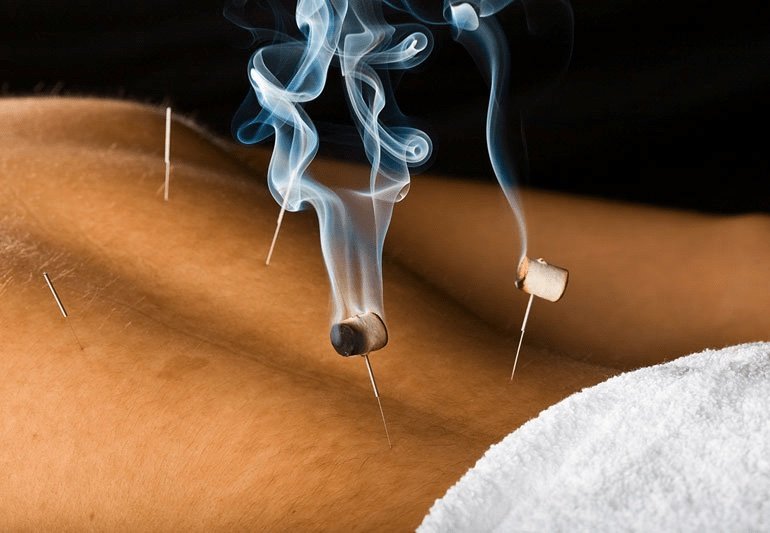 Needle moxibustion: choosing the right equipmentRead more
Needle moxibustion: choosing the right equipment The warm-needle technique (needle moxibustion) rests on a balance...
-
 How to practise moxibustion at homeRead more
Moxibustion is a technique from Traditional Chinese Medicine (TCM) that involves stimulating precise points on the...
-
 Smokeless moxa: why it is less effective than traditional moxaRead more
Why we do not recommend smokeless moxa Therapeutic efficacy and a coherent choice Smokeless moxa is today widely...
Blog categories
Search in blog
Archived posts
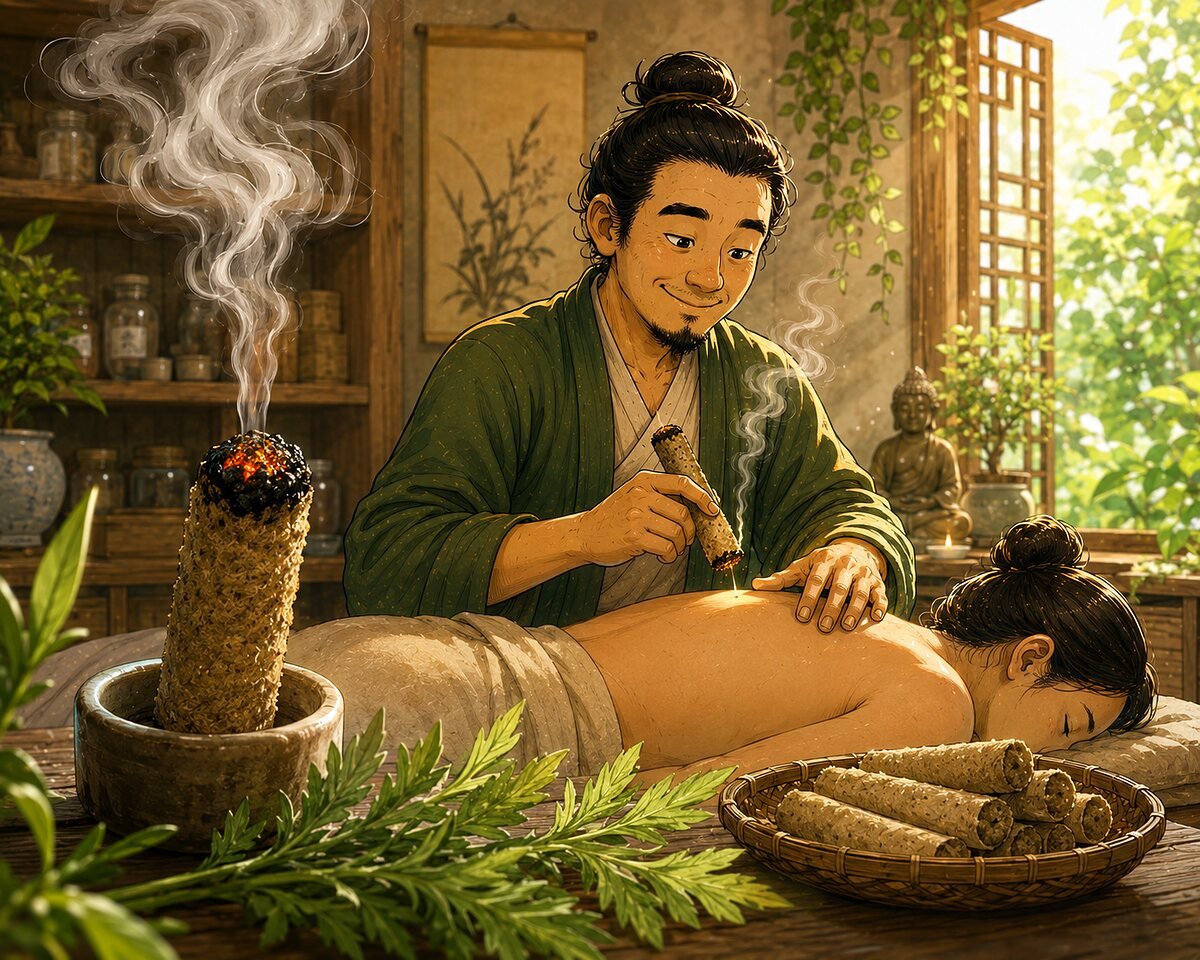
Moxibustion on Yong Quan (KI 1) to guide the fire back to its source
What follows is a largely translated presentation of an article published in 2012 in the Shandong Journal of Traditional Chinese Medicine, by He Yan'e, Tian Dehua and Du Chen, of the School of Acupuncture-Moxibustion and Tuina of the Chengdu University of Chinese Medicine. Its subject: explaining why certain forms of insomnia can be treated by adding fire where there already seems to be too much of it.
Abstract
Treating insomnia due to non-communication between the Heart and the Kidney by moxaing Yong Quan in order to guide the fire back to its source means using the pure yang nature of mugwort fire against the upward blaze of the dragon fire. The method belongs to treatment by accompaniment, the kind that follows the apparent direction of the symptom instead of opposing it.
It addresses two situations: insomnia due to Kidney yang deficiency, in which the true fire of the Kidney floats upwards, and insomnia in which, the Kidney yin being deficient, the fire loses the depth that held it in reserve and no longer returns to its source.
Moxibustion on Yong Quan guides the fire back to its source: it brings the wandering fire back down to its dwelling, Mingmen — the Gate of Life — and the Kidney, so that yang enters yin and sleep comes at night.
Keywords: Yong Quan point; moxibustion; non-communication between the Heart and the Kidney; insomnia; guiding the fire back to its source.
Introduction
Insomnia, which Chinese medicine also calls bu mei, is characterised by difficulty falling asleep or by poor-quality sleep, and its cause is that yang does not enter yin.
Yang enters yin: we sleep. Yang leaves yin: we wake. Harmonising yin and yang is therefore the guiding thread of diagnosis in the treatment of insomnia.
1. Non-communication between the Heart and the Kidney is the main mechanism of insomnia
The Su Wen states that beneath the ministerial fire the qi of water comes to take over, and that beneath the sovereign fire it is the yin essence that takes over. To take over is to succeed in order to temper.
Each of the six qi governs in turn, and while it governs its power dominates. Hence the formula: what is in excess does harm, the relay represses it, and this repression allows life to be engendered and transformed. Wherever an excess risks becoming harmful, nature provides the qi capable of containing it. Man is in the image of heaven, and his body obeys the same rule.
The Heart and the Kidney both belong to the Shao Yin, the level of water and fire, the root of yin and yang. The Heart governs the blood and the vessels, the Kidney governs water and stores the essence.
In good working order, the fire of the Heart is the sovereign fire and the fire of the Kidney is the fire of Life; the fire of Life is the root of the sovereign fire, the sovereign fire is its flame.
The sovereign fire descends into contact with the water of the Kidney and prevents it from turning cold; the fire of Life vaporises the water of the Kidney and raises it to the Heart, preventing the fire of the Heart from blazing alone. Thus are established the communication of the Heart and the Kidney and the mutual accomplishment of water and fire.
Huang Liuhua recalls that the medical literature grants insomnia many causes, but that they hardly ever fall outside disorders of the Heart and the Kidney.
The yin line lodged in the middle of the fire trigram is the root of yin: in descending, it engenders the water-essence. The yang line lodged in the middle of the water trigram is the root of yang: in rising, it becomes the mother of fire.
When the two trigrams accomplish one another, water and fire agree, yang enters yin and we sleep; otherwise yang remains outside and we lie awake.
To this must be added the course of the defensive qi. At night it completes twenty-five circuits in the yin sphere of the body; this course sets out from the Kidney meridian, the Shao Yin of the foot, and reaches the five organs. Since the Shao Yin is the pivot of yin, if this pivot works badly the passage does not take place: one wants to sleep without managing to.
The Shang Han Lun distinguishes, within a disorder of the Shao Yin, a form that turns into cold and a form that turns into heat, according to whether the yin or the yang proper to that level is in excess or in deficit.
Its cardinal statement says that the pulse there is thin and barely perceptible, and that the patient desires only to sleep: understand that he wants to remain lying down without truly sleeping, in a state of dejection, of hazy consciousness, a half-sleep that is not sleep.
This is the cold form, in which the yang of the Heart and the Kidney is deficient and no longer nourishes the spirit — the yang qi, says the classic, nourishes the spirit through its subtle part and the sinews through its supple part. The water being cold and deprived of yang, one dozes without sleeping.
Zhang Jingyue writes in the Jingyue Quanshu that if the yin of Mingmen is deficient, the original yang finds itself without a root: the dragon fire has nowhere left to lodge, it disperses and does not return.
The Shang Han Lun describes the other side: after two or three days of a Shao Yin disorder, with inner agitation and the impossibility of remaining lying down, it is the decoction Huang Lian E Jiao Tang that governs the case.
This is the hot form, and that heat comes from the fact that yin, being deficient, no longer contains yang: an empty heat rises, floats, disturbs the spirit of the Heart, and sleep does not come.
Non-communication between the Heart and the Kidney is therefore indeed the main mechanism of insomnia.
2. The mechanism of guiding the fire back to its source
2.1. What guiding the fire back to its source is
It is the method devised for the precise case in which the fire does not return to its source. Physicians have applied it above all through the pharmacopoeia, notably through cinnamon and aconite.
Wang Bing, commenting on the passage of the Nei Jing where it is said that in serious cases one must go in the direction of the disease, explains that this fire is a dragon fire: dampness stirs it up, water sets it ablaze.
Whoever ignores its nature and claims to break it with water only carries its flame up to the sky, and will have to wait until the matter is exhausted.
Whoever knows its nature reasons against common sense and pursues it with fire: the blaze then subsides of its own accord.
It is this mention of the dragon fire and of pursuit by fire that opens the way to all the later therapeutics of guiding the fire back to its source.
Fire rises, such is its nature. Knowing this dragon nature, and knowing that qi of the same nature call to one another, moxibustion is used to bring the wandering fire back down to its dwelling, Mingmen: that is exactly what guiding the fire back to its source means.
Insomniacs suffering from non-communication between the Heart and the Kidney most often present heat above and cold below, with a flaring of empty fire:
- agitation and insomnia;
- palpitations and abundant dreams;
- weak lower back and knees;
- hot flushes and night sweats;
- dry mouth and throat;
- hot face;
- heat of the five hearts — palms, soles and chest —;
- cold lower limbs.
Against this ascending blaze one then sets the pure yang nature of mugwort fire, in order to bring the wandering fire back to Mingmen, the dwelling of the Kidney.
The procedure therefore belongs squarely to treatment by accompaniment.
2.2. Why moxibustion on Yong Quan guides the fire back to its source
The Shao Yin is the pivot of yin. By day, the defensive qi circulates in the yang sphere and we are awake; by night, it circulates in the yin sphere and we sleep, in twenty-five circuits that set out from the Kidney meridian and reach the five organs.
Let this pivot work badly, and one wants to sleep without managing to.
Zhang Xichun writes that the Kidney is the root of the whole body: it holds in reserve the original yin, the first source of existence, and every fire, on the yin side as on the yang side, takes its foundation there.
Yong Quan is the Well point of the Kidney meridian and lies at the centre of the sole of the foot.
What leaves the body leaves through the Well, and the Well corresponds to the East, to spring, to the beginning of all things.
The qi of the Kidney meridian is like the water of a gushing spring: it comes from beneath the foot and irrigates the five organs and the six bowels, the four limbs and the hundred bones.
Hence the choice of this point to guide the fire back to its source.
In a patient with Kidney yang deficiency — one whose water, having turned cold, no longer nourishes the dragon —, moxaing Yong Quan directly warms and tonifies the Kidney yang: the water ceases to be cold, and the fire that had left its place and was running abroad returns to Mingmen, the dwelling of the Kidney.
In a patient with Kidney yin deficiency — one whose water, having fallen too low, no longer nourishes the dragon —, the same moxibustion likewise brings the wandering fire back down: the spirit of the Heart recovers its peace and sleep returns at night.
2.3. Should moxibustion be forbidden in heat patterns?
Tang Rongchuan writes that if the water of the Kidney is sufficient, the fire remains hidden inside the water, its brilliance stays veiled, the dragon and the thunder do not rise; but that if the water is deficient, the fire no longer returns to its source.
As soon as insufficient water can no longer moisten or nourish the fire of Mingmen, that fire has nothing left to attach itself to, rises a little more each day, and manifests as a picture of heat.
Hence in clinical practice moxibustion is used with caution, so as not to aggravate a Kidney yin deficiency with exuberant fire — and hence the controversy.
Zhang Zhongjing devoted long developments to the accidents and the prohibitions of the methods that use fire, and that is the origin of the later position forbidding moxibustion in heat patterns.
But this theory has a precise historical context: it answered an age in which these methods were fashionable and even used abusively, and its purpose was to recall the importance of preserving the body fluids — not to forbid moxibustion in every heat pattern.
In modern times, Zhou Meisheng defended moxibustion all his life, and late in his career formulated his personal thesis: in heat patterns, moxibustion is precious.
Yang Jizhou, in the Zhen Jiu Da Cheng, judges that the points of acupuncture and those of moxibustion largely overlap, but that the head and the face, where all the yang gather, as well as the chest and the diaphragm, seat of the two fires, do not lend themselves to abundant moxibustion; that the same holds for the back and the abdomen in a patient with yin deficiency and fire; and that the points of the four limbs, for their part, are perfectly suitable.
Nowhere does he say that a patient with yin deficiency cannot be moxaed.
Everything therefore depends on the choice of point. Yong Quan lies at the place of extreme yin, the furthest there is from the organ of fire: it cannot aggravate a yin deficiency with exuberant fire, and it allows, on the contrary, the pure yang nature of mugwort fire to be placed at the service of the descent of the wandering fire, so that the spirit of the Heart recovers its peace and sleep returns at night.
3. Conclusion
Guiding the fire back to its source is an excellent method, bequeathed by the ancients, and moxibustion on Yong Quan is an appropriate application of it in insomnia due to non-communication between the Heart and the Kidney.
Water and fire are the greatest yin and the greatest yang of the human body. By regulating yin and yang through the particularity of this point, the floating fire is brought back down, the original yin returns to Mingmen, water rises and fire descends, the Heart and the Kidney communicate once more, yang enters yin, and sleep comes at night.
Discussion of the mechanism of treating insomnia due to non-communication between the Heart and the Kidney by moxibustion on Yong Quan guiding the fire back to its source
He Yan'e, Tian Dehua, Du Chen — School of Acupuncture-Moxibustion and Tuina, Chengdu University of Chinese Medicine, Sichuan, 610075
Shandong Journal of Traditional Chinese Medicine, 2012, 31(5), pp. 343-344
References cited by the article
- Zhang Zhilin. Diagnosis and treatment of insomnia due to non-communication between the Heart and the Kidney. Zhongyiyao Xuekan, 2004, 22(8): 8.
- Zhang Xichun. Yixue Zhong Zhong Can Xi Lu. Shijiazhuang, Hebei People's Publishing House, 1974: 578.
- Tang Zhaolin, Song Xiaoge. Research on the mechanism of "moxibustion being possible and precious in heat patterns". Journal of the Anhui Institute of Chinese Medicine, 2008, 27(1): 1.
Posted in:
Default category
Related posts
-
How to practise moxibustion at home
Moxibustion is a technique from Traditional Chinese Medicine (TCM) that involves stimulating precise points on the...Read more
-
Needle moxibustion: choosing the right equipment
Needle moxibustion: choosing the right equipment The warm-needle technique (needle moxibustion) rests on a balance...Read more
-
Introduction to moxibustion techniques
Introduction to moxibustion techniques Moxibustion is practised using several techniques. Some are simple and can be...Read more
-
Moxibustion: Summer or Winter, When Should You Really Practise?
As a moxa retailer, I notice a spike in orders every winter — even though the classical texts of Chinese medicine...Read more
-
Moxibustion for insomnia
Shi Mian and An Mian 4, two little-known points to warm with a moxa stick in the evening to re-anchor the yang and...Read more
Leave a comment